
Designing Futures: Civil CAD Projects That Build Your Portfolio
Civil engineering is evolving at a rapid pace, and computer-aided design (CAD) stands at the center of this transformation. For students and professionals, building a Civil CAD Portfolio Projects that reflects both creativity and technical expertise has become more important than ever. Civil CAD projects are not just academic assignments; they are practical demonstrations of your ability to solve real-world engineering problems with precision and innovation.
In today’s competitive industry, employers look beyond degrees. They want to see evidence of skill, problem-solving, and design capability. That is why well-planned Civil CAD projects can make your portfolio stand out. From transportation networks to structural models, every project you complete tells a story of your growth, expertise, and potential.
This blog explores Civil CAD projects that help you develop a portfolio capable of attracting employers, clients, and collaborators. Each section highlights practical ideas, project benefits, and how they contribute to your professional journey.
1. Structural Modeling Projects That Showcase Accuracy
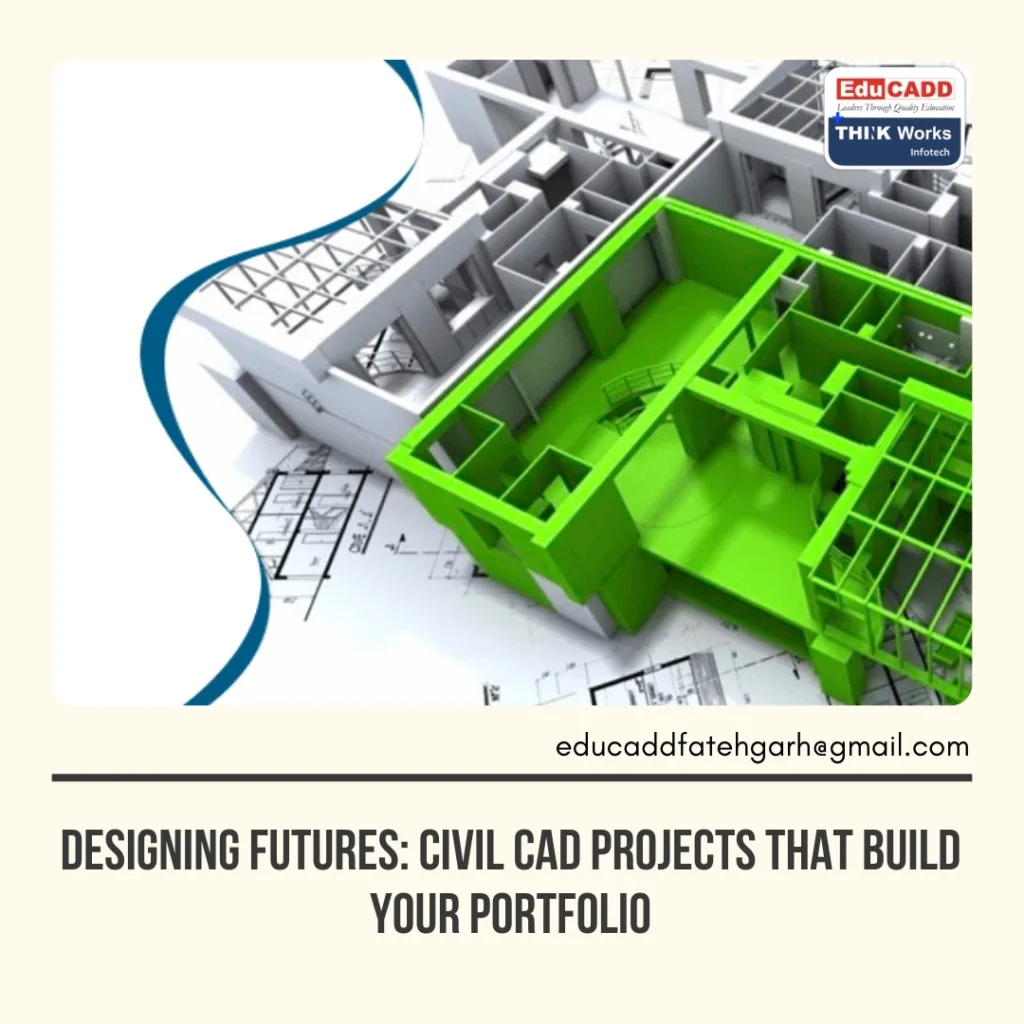
One of the most common Civil CAD applications is structural modeling. These projects test your ability to represent real-life structures with exact measurements and logical design flow. For example, creating a 3D model of a residential building or an industrial warehouse highlights your structural understanding and command over CAD tools.
While working on structural projects, accuracy is key. A strong portfolio should include detailed floor plans, elevation drawings, and reinforcement layouts. You can start small with single-story homes and gradually scale up to complex projects like commercial towers or bridges. Employers often assess the precision of your modeling and the clarity of your documentation.
Transitioning from basic projects to advanced ones demonstrates growth. For instance, if you design a small house early on, follow it with a high-rise apartment building. This shows progress in complexity and confidence. Such Civil CAD projects not only prove your technical ability but also strengthen your portfolio by illustrating attention to detail.
2. Transportation Design Projects That Highlight Planning Skills
Transportation projects are another excellent way to enhance your portfolio. Roads, highways, and intersections require both design and planning expertise. Using CAD, you can develop road alignment layouts, cross-sections, and drainage details. These elements show potential employers that you understand the real-world considerations of infrastructure planning.
You could start with a roadway alignment project involving horizontal and vertical curves. Later, move toward designing a complete highway segment with intersections, service roads, and pedestrian crossings. A project of this scale highlights your ability to integrate design with safety and sustainability.
Employers often look for candidates who can think ahead. Adding simulations, such as traffic flow analysis or parking lot designs, can make your project more dynamic. These Civil CAD projects reveal planning skills and practical foresight, two qualities highly valued in civil engineering firms.
3. Environmental and Water Resource Projects That Demonstrate Responsibility
Civil engineering is not just about buildings and roads. It also involves environmental responsibility. Including CAD projects focused on water resource management or sustainable infrastructure enhances your portfolio by showcasing social awareness.
For example, you could design a stormwater drainage system for an urban area. This project would demonstrate not only your CAD skills but also your understanding of urban flooding issues. Similarly, creating a wastewater treatment layout reflects technical ability and environmental concern.
Sustainable Civil CAD projects stand out in portfolios because they go beyond technical proficiency. They signal that you care about long-term impacts and understand global challenges like water scarcity and climate change. Adding detailed CAD diagrams of channels, reservoirs, or treatment units strengthens your portfolio with unique contributions.
Transitioning into this project type also adds diversity. If your portfolio only contains structural or transportation projects, environmental projects bring balance. Employers appreciate well-rounded professionals who can adapt to multiple sectors of civil engineering.
4. Urban Development Projects That Emphasize Innovation
Cities are expanding rapidly, and urban development is at the core of modern civil engineering. Civil CAD projects focusing on city layouts, smart infrastructure, and public facilities can greatly strengthen your portfolio.
For instance, you could design a smart residential community with roads, utilities, green spaces, and drainage systems. This type of project combines multiple aspects of civil engineering, including transportation, environment, and structural elements. It demonstrates your ability to integrate various components into a single, functional design.
Urban development projects also allow space for creativity. For example, incorporating renewable energy systems or intelligent traffic signals adds innovation. Employers notice when your projects go beyond traditional designs and address modern challenges like sustainability and smart cities.
Including an urban development project in your portfolio shows vision. It communicates that you are not just a designer but also a thinker who can plan for future urban needs. These projects provide a strong impression because they mix technical, creative, and problem-solving skills.
5. Bridge and Highway Projects That Reflect Strength and Durability
Bridges and highways represent some of the most ambitious Civil CAD projects. They require strong fundamentals in structural design, material selection, and load distribution. Adding such projects to your portfolio signals confidence and advanced technical skills.
You could start with a small pedestrian bridge model that demonstrates structural stability. Later, progress to designing multi-span highway bridges or flyovers. These projects often include elements like foundation design, reinforcement detailing, and alignment drawings.
Employers view bridge and highway projects as strong portfolio assets. They represent durability, precision, and responsibility. Since these structures are vital for connectivity and economy, showcasing your ability to design them demonstrates reliability.
Transition words like “furthermore,” “in addition,” and “as a result” can be used while describing the benefits of these projects in your portfolio. By doing so, you strengthen the narrative around your skills and highlight progression from simple to complex designs.
Conclusion
Civil CAD Portfolio Projects are more than drawings on a computer. They are proof of your capability, creativity, and dedication to civil engineering. A strong portfolio built around diverse projects—structural, transportation, environmental, urban, and bridge designs—shows that you are prepared for challenges in the field.
Employers want professionals who can combine technical accuracy with innovative solutions. By carefully selecting and presenting your Civil CAD projects, you not only demonstrate your design skills but also tell a compelling story of your professional journey.
Start small, grow step by step, and include projects that highlight both technical and social responsibility. With the right Civil CAD projects in your portfolio, you position yourself as a capable engineer ready to shape the future of infrastructure.

